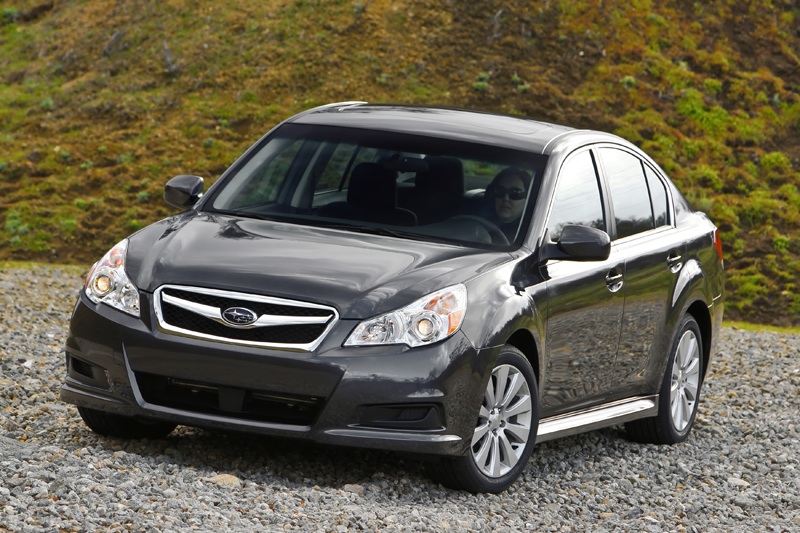
The first generation Subaru Legacy is a car developed by Subaru from 1989-1994. The Legacy was an all new model, and was considered a notable departure from Subaru products in the past. The worldwide introduction of the Legacy was achieved in 1990. Subaru had earned a reputation of building vehicles that were regarded as "quirky" and other Asian manufacturers were bringing more upscale and conventional appearing models to the market. The Legacy appeared at the same time as the USA introduction of Lexus and Infiniti and five years after Acura, and it was interpreted by some as Subaru's attempt at participating in the emerging imported luxury car market. However, Subaru didn't have a V6 or V8 engine. The Legacy was more aerodynamic than previously built products, with soft edges and a more coherent appearance. The sedan has a break in the beltline where it drops down from the windshield to the front door glass, and then juts up from the rear door glass to the rear window, and the beltline is interrupted as it transitions down to the rear window on the wagon. The beltline treatment was used again on the SVX when it was introduced in 1992. The Legacy broke with many Subaru traditions, such as no longer locating the spare tire in the engine compartment, behind the engine and above the transmission, a method also used in the Citroen GS. The Legacy was also the second Subaru to use wheels with five lug nuts instead of four to better cope with the increased horsepower and torque from the powertrain. The Legacy was an all-new model, and was slotted at the top in Subaru's model range, joining the Leone, the Subaru XT coupe, Subaru Justy sub-compact, and the Subaru Rex and Subaru Sambar kei cars in Japan. The Subaru star badge used since the introduction of the 360 was modified, with a more conventional and stylized appearance, in comparison to versions used on previous vehicles. The Legacy began with a 5 door wagon or 4 door sedan body styles with FWD and an optional full-time AWD package, and was introduced in the USA, UK, Germany, the Benelux region of Northern Europe, Japan and Australia. The car was built with many luxury and technological advancements normally found on more expensive vehicles as standard equipment, such as power windows, central locking, fuel injection, air conditioning, vehicle speed sensitive, variable effort, power assist rack-and-pinion steering, alloy wheels, 4-wheel independent suspension (MacPherson struts in front and Chapman struts for the back) with both negative scrub and anti-dive and squat geometery, anti-sway bars front and rear, and 4-wheel disc brakes. Items that were optional that didn't make the vehicle too expensive were 4-channel ABS, licensed from Bosch and air suspension height control, which lowered the vehicle at speeds above 50 mph (80.5 km/h), and also allowed the driver to increase the vehicles ground clearance for off-road conditions. On vehicles equipped with power central locking, the feature is activated from the inside drivers door lock switch only, by pushing the rocker switch to lock or unlock all doors. There is no label on any of the doors that suggest the door lock function is electric. Other doors can be locked or unlocked individually by pushing the respective door lock rocker switch, but it will not lock or unlock the other doors. The outside key door lock can unlock the drivers door only by turning the key partially, or with a complete turn to the left to unlock all doors. According to a translation of the Japanese Wikipedia article on the Subaru Legacy, the Aomori Prefecture and Ibaraki Prefecture police departments have used the Legacy Turbo for patrol cars since the car was introduced and continue to do so. Also mentioned in this translation was an article mentioning that when Subaru began to develop the Legacy, Subaru was facing financial pressure to improve sales from the successes from other Asian competitors and that they used an internal project code of "44B" to refer to the Legacy.


The EJ series flat-4 Aluminium alloy engine, specially developed for the Legacy, was the most powerful engine Subaru had built to date, and the engine is currently offered in many configurations. In an attempt to ensure durability and longevity, Subaru chose to use five main crankshaft bearings. The engine has either SOHC/DOHC architecture and pent-roof, cross flow cylinder firing chambers. The ignition utilized distributorless ignition, using a computer controlled coil pack and spark plug wires to supply the electrical charge. Later versions of this engine used coil packs installed directly on top of the spark plug. Problems detected by the cars' on-board computers are signified by a "check engine" light, alerting the driver that maintenance is needed immediately. The air-fuel mixture is monitored by a mass air flow sensor and emissions are controlled by an oxygen sensor installed in front of a catalytic converter. It also uses reverse flow engine cooling, meaning cool water from the radiator entered the cylinder heads first and then exited through the top of the engine block back into the top of the radiator. The water flow was controlled by the thermostat which is located next to the water pump underneath the engine. Installing the thermostat in this position allows it to more accurately control the temperature of the water as it enters the engine from the cylinder heads first. When it debuted in the US, it was introduced with a slightly larger displacing SOHC 2.2 liter 135 bhp (101 kW; 137 PS) engine that was also used for the European, British and Australian versions over the Japanese market version of DOHC 2.0 liters. The 2.0 liter and 2.2 liter engines fuel delivery were managed with sequential multiport common rail fuel injection called MPFI, and the 1.8 liter engine used a throttle body fuel injection system with single injector called SPFI. The Japanese use the smaller engine because of Japanese vehicle size legislation, which determines the tax to be paid based on the cars dimensions and engine displacement. However, the JDM engine was more powerful, even without the turbo. The JDM DOHC 2.0 liter 148 bhp (110 kW; 150 PS) non turbocharged engine had a dual stage intake manifold where at approximately 3200-3500 engine RPM's four individual valves would allow additional air flow into the engine from a secondary manifold attached and located underneath the primary intake manifold. The DOHC 2.0 liter turbocharged 217 bhp (162 kW; 220 PS) EJ20G engine, which is a prized engine worldwide amongst Subaru enthusiasts, was introduced first in the Legacy and later used in the Impreza WRX when that model was introduced in 1993. In Europe, the Legacy RS Turbo was sometimes referred to as the "Lunacy" Turbo. The Australians were offered the Japanese-spec RS turbo sedan with the DOHC 2.0 liter engine in 1991, and Europe and the UK the same engine in 1992, manual transmission only. The DOHC 2.0 liter turbo also came with a water-cooled intercooler. The USA SOHC EJ22T 2.2 liter 163 bhp (122 kW; 165 PS) turbo was not offered the water-cooled intercooler when it was introduced to them in 1991. The USA turbocharged engine was available with either a manual or automatic transmission. The turbocharged engine was initially offered internationally in the sedan only, with Japanese buyers able to choose between a sedan or wagon on the GT starting in 1990. All turbo models in North America ceased importation from Japan with the end of the first generation in model year 1994 until 2005, when the turbo was re-introduced. This was due to Subaru having upgraded the single turbo used in the Legacy with a twin turbo engine starting with the Second Generation and continued with the Third Generation. The twin turbo configuration was not compatible with left-hand drive vehicles because the turbo on the left side interferes with both the brake master cylinder and steering linkage, among other things.


Some of the affordable luxury items included express up and express down driver side power window, an electric tilt and sliding moonroof with ventilated sunshade, tilt steering with memory feature that allowed the spring loaded steering column to "jump up" and out of the way, power mirrors, 4-way adjustable headrests, velour upholstery and upgraded plush carpeting on the USDM 1990 Legacy LS sedan and wagon, adding leather wrapped steering wheel, gearshift and parking brake handle in 1991. Also in 1991, automatic digital climate control, which was deleted in 1992, and an in-dash CD player, among other things were added to the USA options list. Several exterior paint choices came with a pearlescent appearance, offered only in the USA. Some of the factory installed double DIN (180 x 100 mm panel) 80 watt stereos with the integrated equalizer and cassette players, sourced from Clarion and Panasonic, came with a 3.5mm auxiliary port on the front of the stereo, which enables current digital music devices to be played. The Japanese version of this factory installed stereo was rated at 100W and the volume control knob was situated on the right side of the stereo and the frequency display was on the left. The stereo unit used for the USA and Australia had the volume control on the left and the frequency display on the right. The in-dash CD player, sourced from Clairon, was available on the USA, Japanese and Australian sedan and wagon as an extra cost option, and is easily attached to the double DIN stereo. In 1994, Subaru made available an 80 watt subwoofer/amplifier located under the front passenger seat in the USA, and a side view mirror tweeter speaker kit available as a USA dealer installed accessory with limited availability. Factory stereos standard DIN (180 x 50 mm panel) with 40 watt installed in European vehicles were sourced from Philips or Fujitsu Ten. The European and British versions were installed with standard headlight washers and rear fog lights, so that other drivers could see them in inclement weather and at night, and also received speed sensitive, variable effort power steering as standard. The Australian-spec sedan and wagon were equipped with the rear fog light, but not the headlight washers. The British and Europeans could also install a front bumper bull bar and an 8 mm (0.31 in) thick steel sump guard that extended from the bottom edge of the front bumper to the front suspension. The Europeans could not get an in-dash cupholder located in the small space below the HVAC controls and above the stereo, found in the Australian, USA and Japanese models. In that location instead is a clock, and a button to deploy an electric radio antenna, if so equipped. Clocks are integrated with the OEM stereo internationally. The Japanese versions offered electrically folding power mirrors, 6-way power drivers seat, and infrared keyless remote entry integrated into the ignition key. The GT and VZ had a feature where the driver's door could be opened without using a key or remote, using a driver programmed security code that was entered by pulling the exterior door handle a specific number of times, in accordance with a 4-digit security code found in its memory. This feature was only installed on vehicles with the infrared keyless remote. Vehicles equipped with the infrared keyless remote feature can be identified by having a dark plastic receiver patch installed on the driver's door handle, located directly above the entry lock keyhole. The transmitter installed in the ignition key was aimed at this receiver patch on the door handle. The Japanese could also choose from two factory installed high end stereos and speaker packages from Alpine and Kenwood with integrated CD players, a rear wiper on the back of the sedan as well as the wagon, a spring-loaded ejecting front ashtray, (GT, RS, VZ, and VZ height controlled wagon only), an electrostatic air purifier mounted behind the rear seats on the parcel shelf for the sedan and a combined air purifier/overhead interior light for the wagon, automatic climate control with digital temperature display, vehicle speed sensitive power door locks, halogen fog lights with either clear or yellow lenses, and the ability to switch off the speed sensitive, variable effort power steering on the RS turbo sedan. All vehicles manufactured for sale in Japan with power windows had a feature where the power windows would still operate for 30 seconds after removing the ignition key.
 The Subaru Tribeca is a mid-size crossover SUV sold by Japanese automaker Subaru. The Tribeca was first sold as a 2006 model, with five-seat and seven-seat trims. Built on the Subaru Legacy platform, the Tribeca was inspired by the B9X concept car and has now evolved into its second styling generation. The name Tribeca derives from the TriBeCa neighborhood of New York City. The Tribeca is the only vehicle in this class that comes equipped with AWD as standard equipment, with a FWD or rear wheel drive platform not available. The Tribeca is not sold in Japan, and it was introduced in Australia and New Zealand in late 2006, with an introduction to Germany in 2007. This is mainly due to the similar Subaru Exiga sold in Japan. As a result, the Subaru Tribeca is the only 2000s-introduced vehicle in the current North American Subaru lineup. The Tribeca is available in North America, Europe, Chile, Argentina, Peru, China, Australia and parts of southeast Asia. The B9 Tribeca was featured a new Subaru design language of a triangular grille and a rounded bodyshape. Subaru also used the grille styling on the Impreza, and the JDM Subaru R1/R2 kei car products with a similar reaction. Subaru has since abandoned this styling feature for future models beginning with the 2006 model year.The grille design was not conceived by designer Andreas Zapatinas, rather by Fuore Design, an independent design consulting firm based in Spain, hired by Subaru before Zapatinas involvement. Andreas Zapatinas and his team were responsible for the design of the interior, and the dashboard in particular. According to an LA Times article, the grille design was "meant to convey parent-company Fuji Heavy Industries' glorious history in aviation." The Tribeca was slightly reworked for 2007. The updated model, debuting at the Chicago Auto Show, includes a revised grille, and revised struts, stabilizer bars, and spring rates. Inside, XM Satellite Radio and iPod connectors are pre-wired, while a backup camera and parking assist system are optional for the navigation system. A US$1300 Special Edition package includes a mesh grille, XM radio, and special wheels.
 The 2008 model was introduced at the New York International Auto Show in April 2007. It received a facelift, as well as a larger EZ36 3.6 L H6 256 hp (191 kW) engine, and Subaru claimed 10% better fuel economy while using regular fuel (the 2006 and 2007 use premium) "B9" was dropped from the model name, leaving it just Subaru Tribeca. The back of the vehicle was also mildly redesigned. The tail lamps are more rounded and the "cutout" on the hatch above the bumper has been omitted. The rearmost side window was reshaped. Interior styling is unchanged, but the second row seats have been redesigned for more room and easier access in the third row. The refreshed Tribeca bears much resemblance to concept mock-ups of the unreleased Saab 9-6X, as well as the Chrysler Pacifica. The vehicle is offered with two trim levels; the standard Tribeca and the Limited, which adds a moonroof, leather interior, roof rails for enhanced cargo carrying and a premium audio system with 6-disc in-dash CD changer. The interior colors are somewhat limited to either dark gray cloth or a choice of dark gray or light beige leather interior. The Limited trim level includes an in-dash multifunction screen that displays navigation system information, audio system information, trip computer functions, outside temperatures, maintenance intervals, controls for various vehicle settings, calendar, calculator and memo-taking functions. Video input from rear-seat DVD entertainment system is available with third row seating only, and can only be displayed on the instrument panel center screen if the vehicles transmission is in Park. The cargo volume is 37.6 cu ft (1.06 m3) with the second row seats raised and 74.4 cu ft (2.11 m3) with rear seats lowered. Seating configuration remains at standard second row seats or optional third row seats. The vehicle is equipped with six airbags; two for the front passengers, two side impact airbags that deploy from the outer edge of the front seats and side curtain airbags that drop in front of the front and second row side doors. Two stereo packages are offered, starting with a 100W 6 speaker system with a single-disc in-dash CD player with MP3 compatibility, or a premium stereo with 160W, 9 speakers with subwoofer and a 6-disc in-dash CD changer, also MP3 compatible. Both stereos have auxiliary audio jacks for MP3 players and steering wheel-mounted audio controls.
 Subaru chose to use an aluminum alloy boxer engine in the Tribeca, as well as their other products, to simplify the powertrain implementation of all-wheel drive, in order to reduce powertrain weight, and because of the natural smoothness of the engine design. According to Subaru, since the engine sits in-line or longitudinal with the transmission, instead of being offset or transverse as can be commonly found by other FWD and AWD vehicles, body roll is minimized. The weight of the engine and automatic transmission are balanced instead of being offset. The power delivery is also direct from the transmission to the front wheels, and to the rear wheels through a rear differential, which is limited slip on some models. The front differential is integrated into the Subaru transmission. Other AWD vehicles were first engineered as either front or rear wheel drive, but were modified with an additional, external transfer case and asymmetrical drive shafts to power the additional wheels. The boxer engine also affords a low center of gravity, and a balanced chassis because the engine sits low in the engine bay and close to the ground, as opposed to other vehicles, allowing the vehicle to stay more stable than some vehicles in moderate to high speed manoeuvres. Other manufacturers counteract the offset weight by evenly distributing their powertrains' weight. The boxer design also provides near-perfect vibration mitigation due to the fact that the movement of each piston is exactly countered by the corresponding piston in the opposing cylinder bank, eliminating the need for a harmonic balancer attached to the front of the engine at the crankshaft, and that the movement of the pistons is on a horizontal plane. The only vibration caused by the boxer engine is secondary caused by the cylinders being slightly offset on opposing banks. This vibration, however, is minimal and is all but eliminated when the engine is mounted in the engine bay. Torque steer is also reduced with this type of power train layout. This is achieved by having the front driveshafts being of equal weight and length, and extend from the transmission to the front wheels at almost perpendicular from the transmission. The Tribeca won best interior of the year by Ward's Auto, a benchmark agent similar to JD Power, but more subjective. Also, it was considered Most Innovative Concept at the 2004 Detroit Auto Show. The Tribeca scored well on Insurance Institute for Highway Safety crash tests. It earned a "Top Safety Pick" ranking.